Computer Memory Chip Shortage in 2026: Causes, Market Impact and What PC Buyers Should Know
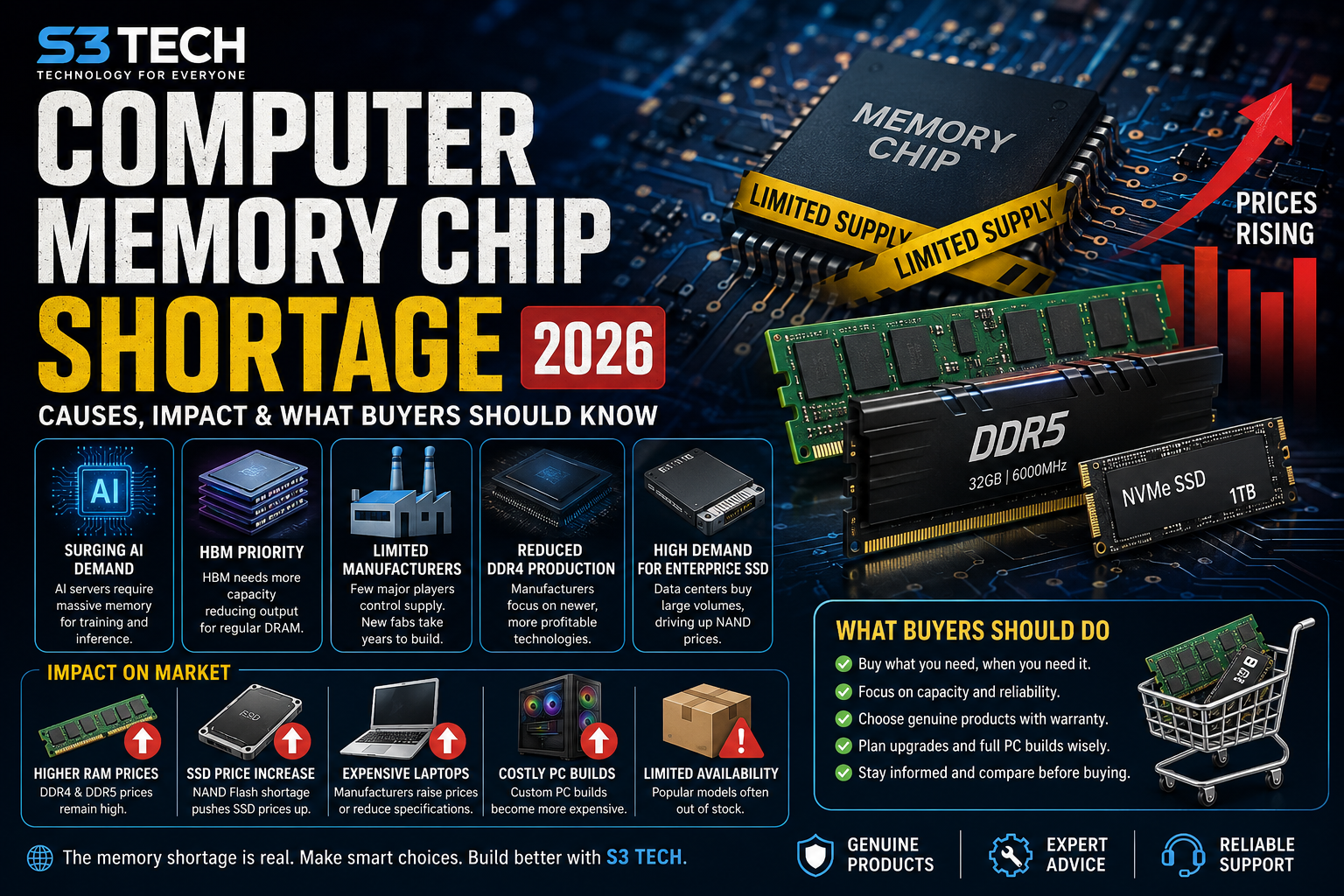
Computer Memory Chip Shortage in 2026: Causes, Market Impact and What PC Buyers Should Know
The global computer industry is experiencing one of its most significant memory supply disruptions in recent years. Prices of essential memory components -including desktop and laptop RAM, SSD storage, server memory, graphics memory and high-bandwidth memory have increased sharply, while the availability of some models has become less predictable.
Unlike an ordinary temporary shortage, the current situation is being driven by a major structural change in the semiconductor industry. Memory manufacturers are prioritising components for artificial intelligence servers, cloud data centres and enterprise systems because these products are in extremely high demand and offer better profit margins.
As a result, less manufacturing capacity is available for conventional consumer products such as DDR4 RAM, DDR5 RAM, laptop memory, SATA SSDs and NVMe SSDs.
For consumers and businesses in Nepal, this situation may lead to higher computer prices, frequent price changes, limited product availability and increased costs for custom PC builds and upgrades.
In this article, S3 TECH explains the causes of the 2026 computer memory shortage, its effects on the global and Nepalese markets, and what buyers should consider before purchasing or upgrading a computer.
What Is a Computer Memory Chip Shortage?
A computer memory chip shortage occurs when the demand for memory components becomes greater than the amount manufacturers can produce and deliver.
The term “computer memory” covers several different products:
-
DRAM chips used in DDR4 and DDR5 RAM
-
LPDDR memory used in laptops and mobile devices
-
NAND Flash used in SATA SSDs and NVMe SSDs
-
HBM used in AI accelerators and high-performance GPUs
-
GDDR memory used in graphics cards
-
Enterprise memory used in servers and data centres
In 2026, the shortage is affecting both volatile memory, such as RAM, and non-volatile memory, such as SSD storage.
IDC describes the current situation as more than a normal supply-and-demand cycle. It represents a strategic reallocation of semiconductor production capacity from consumer electronics toward higher-value AI and enterprise products. IDC expects global DRAM and NAND supply growth in 2026 to remain below historical levels, at approximately 16% and 17% respectively.
Why Is There a Memory Chip Shortage in 2026?
Several interconnected factors are responsible for the current market situation.
1. Rapid Growth of Artificial Intelligence
Artificial intelligence is currently the biggest driver of memory demand.
AI servers require enormous quantities of high-speed memory to train and run large language models, generate images and videos, process business data and support cloud-based AI services. Companies operating large data centres are purchasing HBM, server DRAM and enterprise SSDs in very high volumes.
Major technology companies are investing heavily in AI infrastructure, and memory manufacturers are redirecting production resources toward these customers.
TrendForce reports that increased HBM wafer consumption is reducing the production capacity available for conventional DRAM. It expects this supply pressure and strong pricing environment to continue through 2027.
2. HBM Requires More Production Capacity
High-bandwidth memory is more complex to manufacture than ordinary DDR5 memory.
HBM uses multiple memory dies stacked together and connected through advanced packaging technology. This manufacturing process consumes more wafer capacity and requires specialised equipment.
Micron has stated that HBM has approximately a three-to-one production trade-off compared with DDR5. In practical terms, using production capacity for HBM can significantly reduce the number of conventional DDR5 components that can be manufactured from the same resources. Micron also expects tight DRAM and NAND market conditions to continue through and beyond 2026.
Memory manufacturers therefore face an important business decision: use limited factory capacity for standard consumer RAM or allocate it to more profitable HBM and server products.
Most manufacturers are prioritising the second option.
3. Limited Number of Major Memory Manufacturers
The global DRAM market is highly concentrated. Most advanced memory chips are produced by a small number of companies, primarily:
- Samsung Electronics
- SK hynix
- Micron Technology
When these companies adjust their production priorities, the effect is felt throughout the global computer market.
Building a new semiconductor fabrication plant is extremely expensive and can take several years. Even when companies announce new factories, those facilities cannot immediately solve a current shortage.
Micron, for example, has been accelerating equipment installations and factory development, but some of its additional production capacity will only begin contributing from 2027 onward, while other projects are planned for later years.
4. Reduced Production of Older Memory Technologies
The shortage does not affect only the latest DDR5 products. Older DDR4 memory may face even greater availability problems.
Manufacturers are gradually shifting production lines from older technologies to newer and more profitable products. However, millions of existing laptops, desktops, office computers and servers still depend on DDR4 memory.
This creates an unusual market situation: an older memory generation does not always become cheaper. When production falls faster than demand, the price of DDR4 products can remain high or increase.
Customers upgrading an older laptop or desktop may therefore discover that compatible DDR4 modules are more expensive or harder to find than expected.
5. Strong Demand for Enterprise SSD Storage
Artificial intelligence systems require not only powerful processors and HBM but also extremely fast and high-capacity storage.
AI training datasets, model files, databases and generated content require substantial storage capacity. Data centres are therefore purchasing large numbers of enterprise SSDs.
TrendForce projected an exceptionally strong increase in enterprise SSD prices during the first quarter of 2026 because demand exceeded available production capacity. It also reported significant increases across conventional DRAM and NAND Flash contract prices.
This enterprise demand influences the supply and pricing of consumer NAND products, including:
- 256GB and 512GB SSDs
- 1TB and 2TB NVMe SSDs
- SATA SSDs
- USB flash drives
- Memory cards
- Laptop and desktop storage
Current Memory Market Situation in 2026
The memory market experienced extremely sharp price increases during the first half of 2026.
TrendForce estimated that conventional DRAM contract prices could rise by 90% to 95% quarter over quarter during the first quarter of 2026. It also projected NAND Flash contract price growth of 55% to 60%, while PC DRAM prices were expected to more than double during the same period.
By the third quarter of 2026, the rate of increase began to slow. However, this does not necessarily mean that the shortage has ended.
Current projections indicate that conventional DRAM prices may still rise by approximately 13% to 18% quarter over quarter during Q3 2026, while NAND Flash prices may increase by around 10% to 15%. The slower growth is mainly because consumers and device manufacturers are reaching affordability limits—not because memory supply has fully recovered.
In other words, prices may rise more slowly, but meaningful price reductions are not yet guaranteed.
Impact on Desktop and Laptop RAM Prices
The most direct impact for computer users is the increasing price of RAM.
DDR4 RAM
DDR4 remains common in affordable laptops, office desktops and older gaming PCs. However, manufacturers are reducing their focus on DDR4 as they move toward DDR5 and AI-related products.
This can lead to:
- Higher prices for 8GB and 16GB DDR4 modules
- Limited availability of specific speeds
- Fewer choices from major brands
- Price differences between identical capacities
- Difficulty matching existing RAM modules
Users planning to upgrade an older system should verify its maximum RAM capacity, supported frequency, module type and available slots before purchasing.
DDR5 RAM
DDR5 is now standard in many modern Intel and AMD systems. Although production is increasing, demand from new laptops, desktops, workstations and servers remains strong.
Popular DDR5 configurations include:
- 8GB DDR5 for entry-level computers
- 16GB DDR5 for general productivity and gaming
- 32GB DDR5 for gaming, content creation and professional work
- 64GB or more for advanced editing, engineering and workstation applications
Prices may vary frequently depending on chip supply, speed, latency, brand and whether the product includes RGB lighting or a heat spreader.
Laptop RAM
Laptop memory can be particularly affected because compatibility differs between models.
Some laptops use replaceable SO-DIMM modules, while others use soldered LPDDR memory that cannot be upgraded. Buyers should examine the laptop’s memory configuration before purchase rather than assuming that an upgrade will be possible later.
During a shortage, purchasing a laptop with sufficient factory-installed memory may be safer than relying on a future upgrade.
Impact on SSD Prices and Availability
NAND Flash is the primary technology used in SSD storage. When NAND supply becomes tight, SSD costs increase.
The affected categories include:
- 2.5-inch SATA SSDs
- M.2 SATA SSDs
- PCIe 3.0 NVMe SSDs
- PCIe 4.0 NVMe SSDs
- PCIe 5.0 NVMe SSDs
- External SSDs
- Enterprise storage drives
Entry-level 256GB and 512GB SSDs remain important for affordable laptop and desktop upgrades. However, the best value is increasingly found in 1TB models because modern applications, games and operating systems require more storage.
Customers should not select an SSD based only on capacity and price. Other important factors include:
- NAND type
- Controller quality
- Read and write performance
- Endurance rating
- Warranty
- Thermal management
- Brand reliability
- Product authenticity
Extremely cheap or unknown SSDs may use lower-quality components, inconsistent controllers or misleading capacity information. During a shortage, the risk of low-quality and counterfeit products entering price-sensitive markets may increase.
Impact on Laptop and Desktop Prices
Memory is a significant part of the total manufacturing cost of a computer.
When RAM and SSD prices increase, laptop and desktop manufacturers may respond in several ways:
- Increase the retail price
- Reduce the installed RAM
- Use a smaller SSD
- Remove a second memory module
- Limit upgrade options
- Delay product launches
- Reduce production of low-margin models
For example, a laptop generation that previously included 16GB RAM and a 512GB SSD at a certain price may later be offered with only 8GB RAM, or its retail price may increase.
IDC notes that rising memory costs are placing pressure on device manufacturers and may force companies to increase prices, reduce specifications or use a combination of both approaches.
Consumers should therefore compare complete specifications rather than comparing only processor names.
Two laptops may use the same Intel Core or AMD Ryzen processor but provide very different value based on:
- RAM capacity
- Whether the RAM is upgradeable
- SSD capacity
- Display quality
- Battery size
- Graphics capability
- Warranty and after-sales support
Impact on Custom Gaming PC Builds
The memory shortage also affects the total cost of a custom gaming PC.
RAM and SSDs may represent a smaller portion of the budget than the processor or graphics card, but sharp increases can still affect the final configuration.
A customer working with a fixed budget may need to choose between:
- 16GB RAM now with an upgrade planned later
- 32GB RAM for better long-term performance
- A 512GB high-quality SSD
- A 1TB value-oriented SSD
- Faster memory with RGB
- Standard-speed memory with better capacity
For most modern gaming computers in 2026, 16GB should be considered the practical minimum. However, 32GB is increasingly recommended for demanding games, multitasking, live streaming, video editing and future-proofing.
Customers should avoid reducing the quality of critical components such as the power supply simply to compensate for higher RAM or SSD prices. A balanced PC build is more important than maximising one specification.
S3 TECH recommends selecting components according to the intended workload, total budget and future upgrade plan.
Impact on Graphics Cards
Graphics cards use specialised video memory such as GDDR6 or GDDR7. Although graphics memory has a separate market from standard desktop RAM, it is still connected to the wider semiconductor supply chain.
Changes in memory allocation can influence:
- Graphics card manufacturing costs
- Availability of particular VRAM capacities
- Price differences between GPU variants
- Production priorities for professional and AI-focused GPUs
- Delivery schedules for gaming graphics cards
AI accelerators are particularly attractive to manufacturers because enterprise customers purchase them in large volumes. This can encourage suppliers to prioritise high-end data-centre products over lower-margin consumer hardware.
However, the impact may vary by GPU model. Weak demand in certain consumer segments can sometimes limit price increases even when upstream memory costs remain high.
Impact on the Nepalese Computer Market
Nepal depends heavily on imported computers, RAM, SSDs and other semiconductor-based products. Local retail prices are therefore influenced by more than the factory price alone.
The final price in Nepal may be affected by:
- International memory prices
- Supplier and distributor inventory
- Currency exchange rates
- Freight and logistics costs
- Customs and import expenses
- Product availability in regional markets
- Warranty coverage
- Changes in manufacturer pricing
Because products travel through several stages before reaching Nepal, international price increases may appear in the local market after a delay.
Similarly, even when global prices begin to stabilise, Nepalese retail prices may not fall immediately. Existing inventory may have been purchased at a higher cost, and replacement stock may still be expensive.
This may cause frequent price changes, especially for:
- 8GB and 16GB laptop RAM
- 16GB and 32GB desktop memory kits
- 512GB and 1TB NVMe SSDs
- Gaming laptops
- Business laptops
- Custom desktop computers
- Workstations
- Servers
Customers should therefore confirm the latest price and stock status before making a final purchase decision.
Should You Buy RAM or an SSD Now?
There is no single answer for every customer.
Consider buying now when:
- Your computer does not have enough RAM for daily work
- Your hard drive is slowing down the entire system
- You need the upgrade for business or study
- A compatible product is available at a reasonable price
- Your preferred model includes a reliable warranty
- Delaying the purchase would reduce your productivity
Consider waiting when:
- The upgrade is optional rather than necessary
- You already have sufficient RAM and storage
- You are planning a completely new system
- You are comparing multiple upcoming platforms
- Current prices exceed your available budget
Trying to predict the exact lowest price is difficult. Memory markets can change rapidly, and a lower price is not guaranteed in the immediate future.
For essential upgrades, purchasing a genuine and compatible product at a fair current price may be more practical than waiting indefinitely.
How Buyers Can Reduce the Impact of the Shortage
Choose Capacity Before Extreme Speed
For many users, 32GB of standard-speed RAM offers more practical value than 16GB of extremely fast premium memory.
Capacity is particularly important for:
- Video editing
- Graphic design
- Software development
- Virtual machines
- Engineering applications
- Streaming
- Heavy browser multitasking
Select a Reliable SSD
Avoid selecting the cheapest storage device without checking its quality and warranty.
A reliable SSD protects important files and provides more consistent long-term performance.
Check Upgradeability Before Buying a Laptop
Confirm whether the laptop includes:
- Replaceable RAM
- Soldered memory
- One or two SO-DIMM slots
- An additional M.2 slot
- A replaceable SSD
- A maximum supported capacity
Buy Genuine Components
Use trusted sellers and verify:
- Brand packaging
- Serial number
- Warranty
- Product model
- Capacity
- Speed
- Compatibility
Plan the Entire PC Build Together
When building a computer, evaluate the processor, motherboard, RAM, SSD, graphics card, power supply and cooling system as one complete configuration.
This helps prevent overspending on one part while compromising another essential component.
When Could the Memory Shortage Improve?
A meaningful improvement depends on several factors:
- New semiconductor factories becoming operational
- Additional cleanroom capacity
- Better HBM manufacturing efficiency
- Slower AI infrastructure investment
- Increased competition between memory manufacturers
- Reduced stockpiling by large data-centre customers
- Weakening consumer or enterprise demand
However, new factories require years to build and qualify for mass production. Micron expects tight market conditions to continue through and beyond 2026, while TrendForce expects strong supplier pricing power to extend through 2027.
Therefore, buyers should not assume that RAM and SSD prices will quickly return to their earlier levels.
Temporary price corrections may occur, but the wider market is likely to remain volatile.
What S3 TECH Recommends
S3 TECH recommends that customers make purchasing decisions based on their actual requirements rather than reacting emotionally to short-term market changes.
For general office work and study:
- 8GB RAM is usable for basic tasks
- 16GB RAM is the recommended practical standard
- A 512GB SSD provides a good balance of storage and cost
For modern gaming and multitasking:
- 16GB RAM is the minimum practical configuration
- 32GB RAM is recommended for better long-term value
- A 1TB NVMe SSD is preferable for larger game libraries
For video editing, development and professional workloads:
- 32GB RAM should be considered the starting point
- 64GB may be appropriate for advanced projects
- A reliable 1TB or 2TB NVMe SSD is recommended
For existing computers, an SSD and RAM upgrade can still be one of the most cost-effective ways to improve performance without buying a completely new system.
Conclusion
The 2026 computer memory shortage is being driven primarily by the rapid expansion of artificial intelligence, cloud computing and enterprise data centres. Memory manufacturers are allocating more production capacity to HBM, server DRAM and enterprise SSD products, reducing the supply available for ordinary laptops, desktops and consumer upgrades.
This shift is affecting the prices and availability of DDR4 RAM, DDR5 RAM, laptop memory, SATA SSDs, NVMe SSDs, laptops, desktops and custom gaming PCs.
Although the pace of price increases may slow during the second half of 2026, supply remains tight, and significant price relief may take time.
For buyers in Nepal, the best approach is to compare complete specifications, confirm current stock, choose genuine products and plan upgrades carefully.
S3 TECH provides genuine computer components, laptop and desktop upgrades, SSD installation, RAM upgrades and professional custom PC-building services in Nepal. Our team can help customers select compatible components according to their system, workload and available budget.